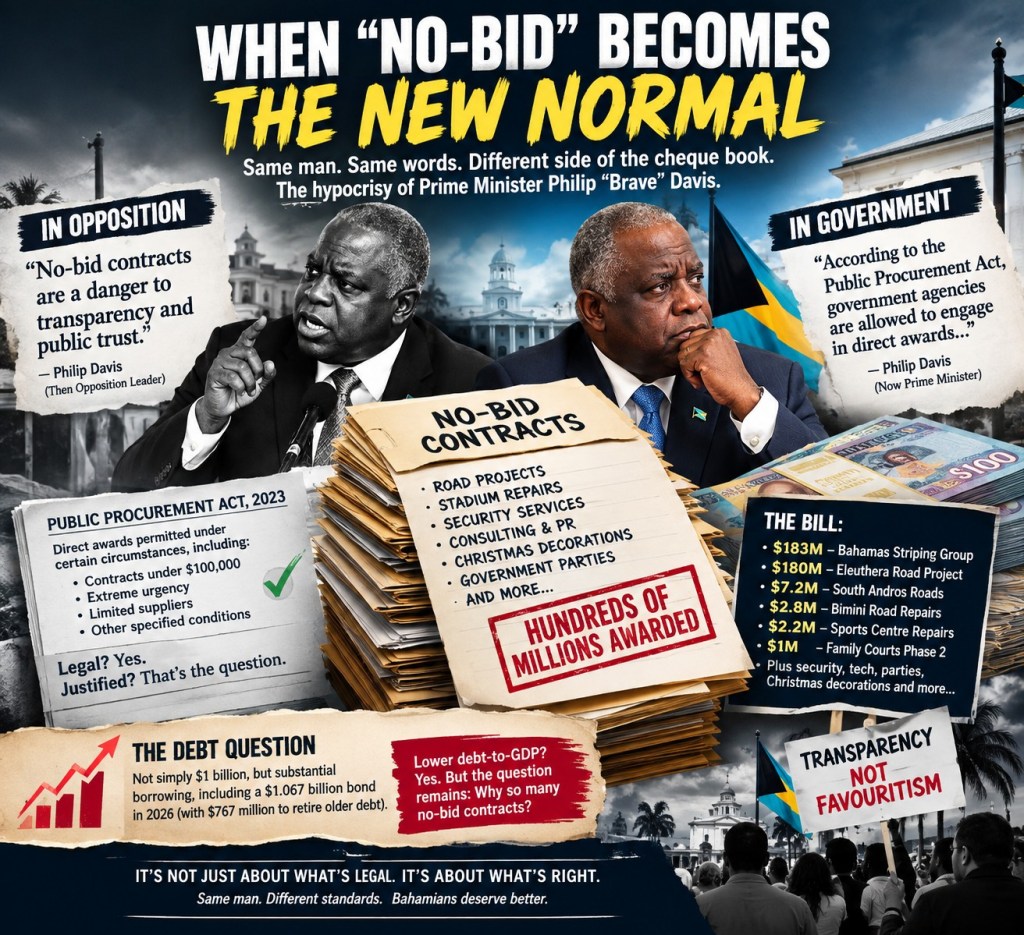
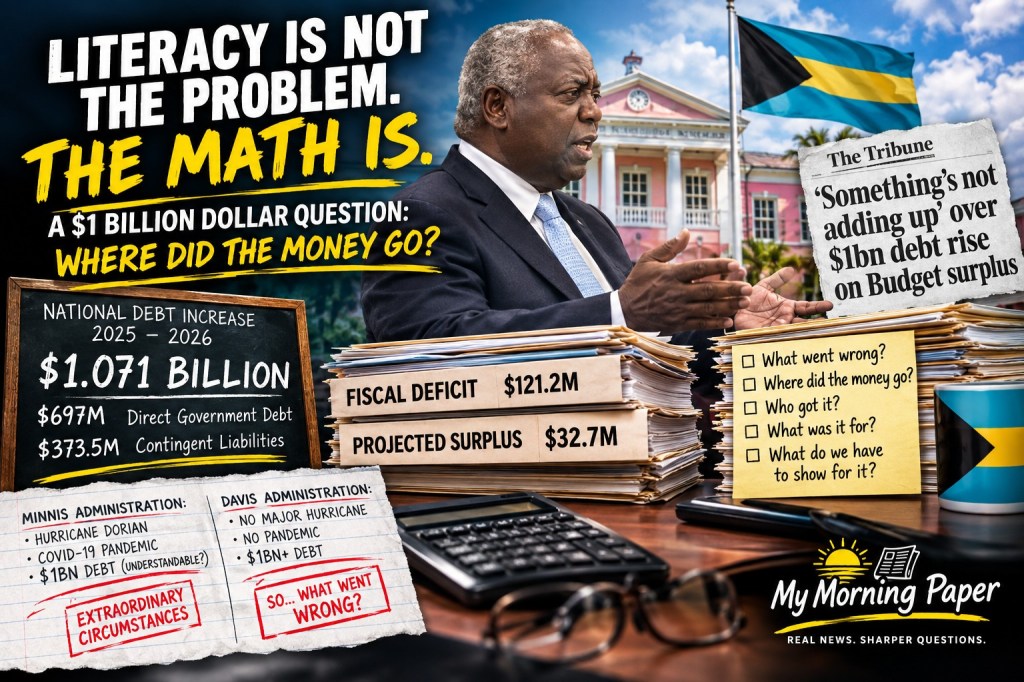
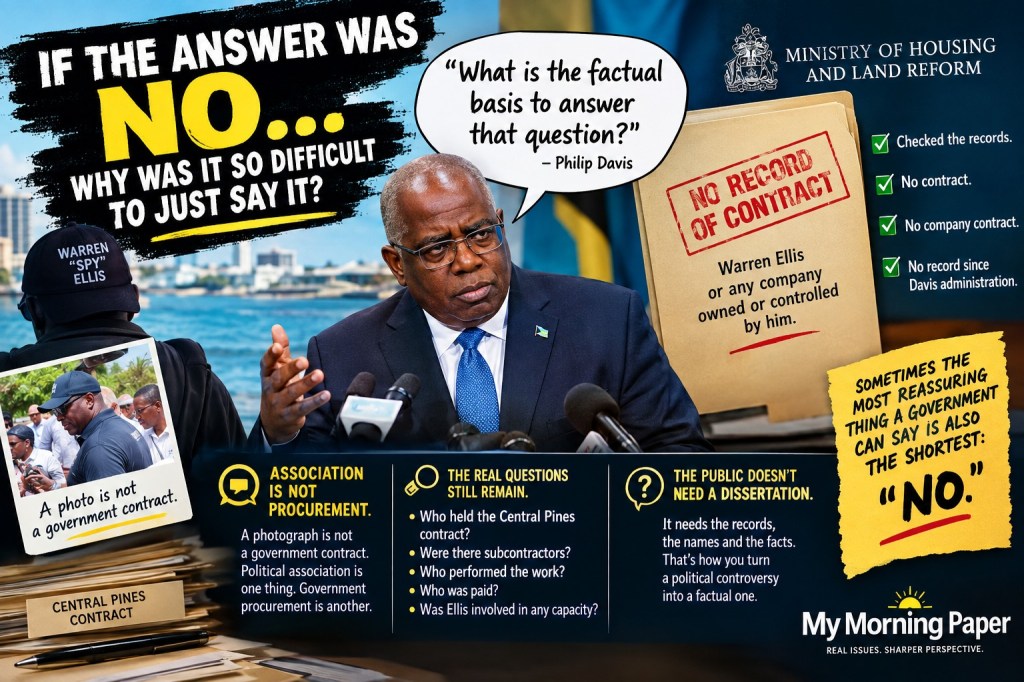
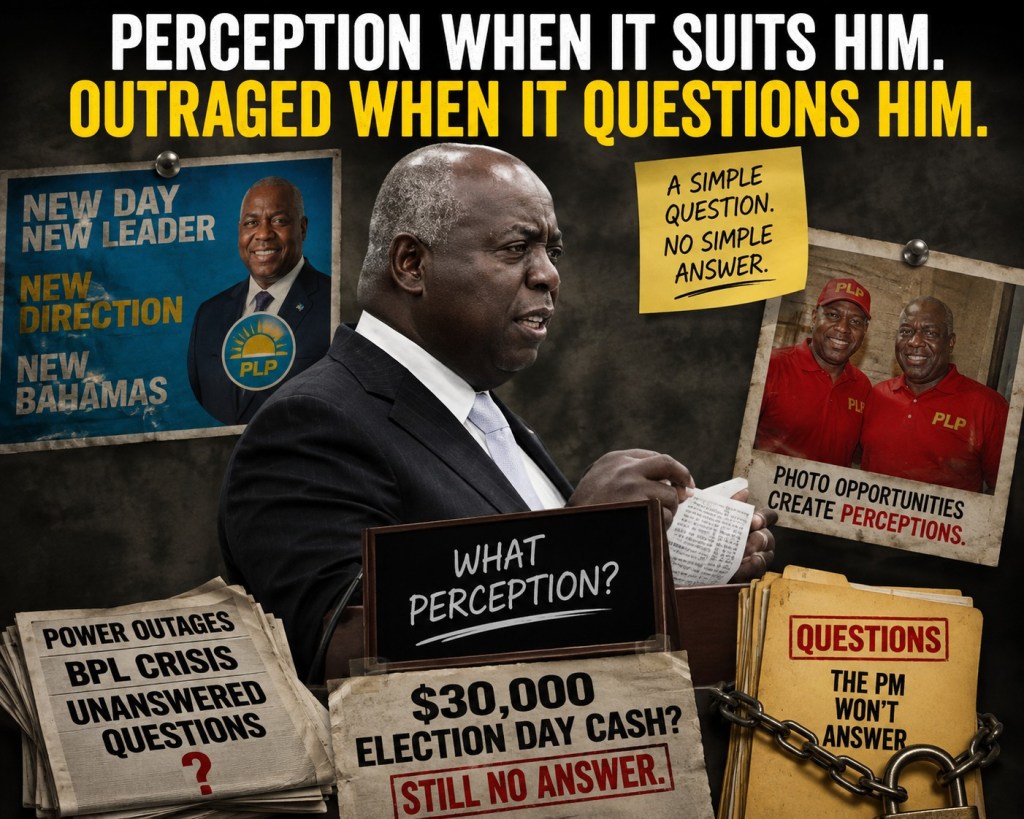
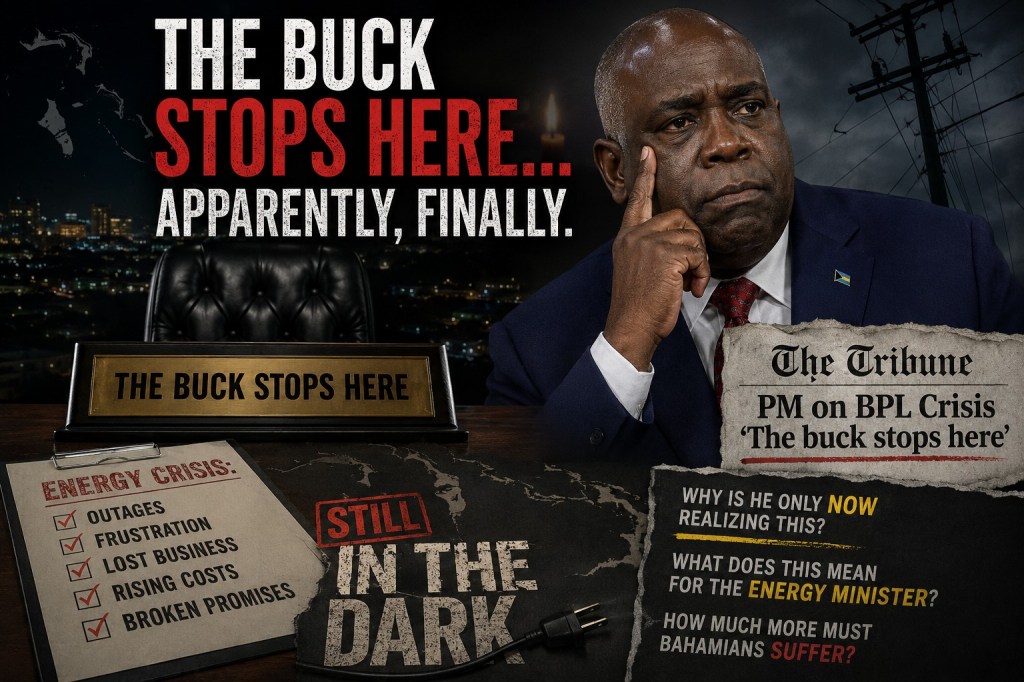
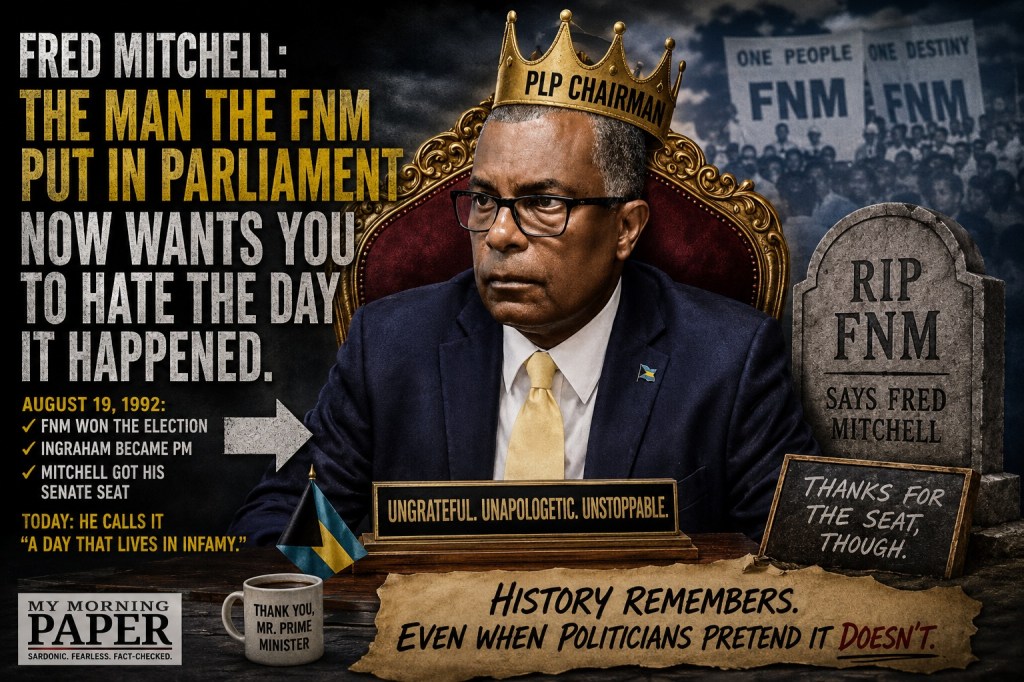
My Morning Paper 11th March 2026 – A Public Town Hall… or Private Party Meeting? The Curious Case of Fred Mitchell’s “Civic-Minded Bahamians”

Listening to the recent voice note by Fred Mitchell, chairman of the governing Progressive Liberal Party, one could be forgiven for thinking that a dramatic political ambush took place at a quiet, noble gathering of “civic-minded Bahamians” in Freeport.

According to Mitchell’s retelling, the meeting was meant to “clear the air” about the arbitration ruling between the Government of The Bahamas and the Grand Bahama Port Authority.

But then—cue the dramatic music—Opposition Leader Michael Pintard allegedly “crashed the party,” only to be booed and condemned for daring to defend the Port Authority families.

Now that is quite a story. Almost cinematic.

But it raises a few awkward questions.

First, Pintard is not exactly a random passer-by who wandered into the wrong wedding reception. He is an elected Member of Parliament representing a constituency in Grand Bahama and the leader of the Free National Movement. He also lives on the island.

If a meeting is held in Freeport about the future governance and economic structure of Freeport, one would imagine the island’s elected national leader of the opposition might have a legitimate reason to attend.

Unless, of course, “town hall meeting” actually meant something closer to “PLP supporters’ appreciation night with optional booing.”

Because Mitchell described the gathering as public.

Yet the reaction suggests it may have been public in the same way some birthday parties are public: everyone is welcome… as long as they agree with the host.

What Pintard Actually Said (Versus What the PLP Claims)

Mitchell’s voice note suggests that Pintard was “taking the side” of Rupert Hayward and the families controlling the GBPA.

That characterization is politically convenient—but not entirely accurate.

What Pintard has actually argued publicly is far narrower:

• The arbitration ruling clarified the legal obligations between the parties.
• The tribunal did not determine that the GBPA currently owes a specific amount in back fees.
• Any future obligations must be assessed according to the ruling and applicable agreements.

In other words, Pintard’s position was essentially: follow the ruling as written.

That is not quite the same thing as defending the Port Authority families.

But in modern politics, nuance is often the first casualty—especially when a good booing opportunity presents itself.

What the Tribunal Actually Decided

The arbitration between the Grand Bahama Port Authority and the Government of The Bahamas centered on regulatory authority and fees in the Freeport area governed under the Hawksbill Creek Agreement framework.

Key points widely reported from the ruling include:

• The tribunal rejected the government’s attempt to immediately collect large sums in alleged historical arrears from the GBPA.
• The ruling clarified regulatory responsibilities between the parties going forward.
• The issue of any specific financial liability was not resolved as a payable lump sum in the way the government had initially framed it.

Which is why the government declaring total victory—and critics declaring total defeat—both sound a bit like fans arguing over a cricket match that was actually called off for rain.

A “Dead Issue”… Except for the Political Theatre

Ironically, even Mitchell himself has suggested the matter is effectively settled.

Which raises the obvious question:

If the issue is “dead,” why are we still holding revival meetings for it?

The reality is that the tribunal has ruled, the legal framework has been clarified, and both sides must now operate within that framework.

The Grand Bahama Port Authority has indicated it will comply with obligations moving forward. The historic arrears claim—at least in the sweeping form originally presented—did not survive the arbitration process.

So perhaps the bigger question for the New Day Progressive Liberal Party government is this:

After more than four years in office, what exactly is the development plan for Grand Bahama?

Because while political voice notes and town-hall theatrics may entertain the faithful, they do not rebuild roads, attract investors, or revive an economy.

At some point, the speeches must give way to actual work.

Grand Bahama has heard quite enough talking.

The Bahamian people deserve better.

END

My Morning Paper – 10th March , 2026 – Clearing the Air… or Clearing the Narrative?

Just as the dust had begun to settle following the arbitration ruling between the Government of The Bahamas and the Grand Bahama Port Authority (GBPA), the New Day Progressive Liberal Party (PLP) suddenly found the need to convene a town hall meeting in Freeport to “clear the air.”

This is curious, because the air—at least legally—had already been cleared.

The international tribunal’s ruling was quite plain: the government’s claim that the GBPA owed $357 million for administrative services between 2018 and 2022 was dismissed.

Instead, the tribunal determined that the mechanism the government relied upon had been replaced by a later arrangement negotiated in the 1990s, meaning the government could not retroactively calculate and enforce those claims in the way it attempted.

In short, the headline number that fueled years of political rhetoric—$357 million—did not survive arbitration.

Yet, somehow, once the ruling landed, the country was suddenly invited to a political “clarification session.”

One must ask: if the tribunal’s findings were already on record, what exactly needed clearing?

Then came the convenient narrative shift, according to reporting in The Nassau Guardian, Prime Minister Philip “Brave” Davis told attendees at the Belinda M. Wilson Centre that the GBPA may now be building a legal strategy claiming it “cannot pay” the liabilities the government says it is owed.

If that is indeed the Port Authority’s strategy, then the obvious question becomes:

Is the PLP now building its own defense—an “at least we tried” defense?

Because the uncomfortable political reality remains unchanged.

The government entered arbitration seeking $357 million, and that claim was dismissed in full by the tribunal.

Yes, the ruling confirmed that a payment mechanism between the government and GBPA exists and can be reviewed going forward, but the specific financial windfall that had been repeatedly invoked in speeches, press conferences, and political commentary did not materialize.

That fact alone explains why a sudden town hall meeting might now be necessary.

It is my opinion that the Davis administration entered this legal battle knowing the path to recovering $357 million would be extremely difficult—if not legally untenable.

Prime Minister Davis is widely regarded as an experienced attorney, a King’s Council. It strains credibility to believe that someone with his legal background would not have carefully weighed the strength of the claim before proceeding.

But politics often operates by a different set of incentives.

If you bring the claim and lose, you can still claim that you fought for the people.

If you bring the claim and win, you are a national hero.

And if you lose?

Well, you simply hold a town hall meeting and start explaining why the real story is something else entirely.

After all, if the government gambled with the people’s money in pursuit of political mileage, what’s the harm? The Minister of Finance assures us there will still be a $75 million surplus.

So why worry?

In the end the Hawksbill Agreement Was Clarified — But The Money Was Not Recovered

To be fair, the tribunal did clarify important aspects of the Hawksbill Creek Agreement.

It confirmed that the government retains regulatory authority in Freeport and that a payment mechanism between the GBPA and the state remains enforceable through 2054.

Those are legitimate outcomes.

But they are not the same as recovering $357 million.

And for months, that $357 million figure was the centrepiece of the government’s public messaging.

Now, with that claim dismissed, the narrative appears to be shifting.

From Arbitration to Political Theatre, which brings us back to the town hall meeting.

What was presented as an effort to “clear the air” looked, to many observers, more like a political rally. The event featured the Prime Minister alongside attorneys Gregory Moss, Ernie Wallace, and Terrence Gape, while opposition figures attempting to speak were reportedly heckled by attendees.

For an event supposedly focused on national clarity, it appeared to have a very partisan atmosphere.

Opposition leader Michael Pintard went so far as to describe the gathering as essentially a PLP rally rather than a neutral forum for discussion.

And perhaps that is precisely the point.

Because if the main objective—recovering $357 million—was not achieved, then the next best strategy is to reframe the conversation.

Suddenly the issue is no longer the missing $357 million.

Now the focus is on future payment mechanisms, potential negotiations, and hypothetical defences the GBPA might raise.

In politics, the best distraction from a failed objective is often a brand-new narrative.

What makes the entire episode even more troubling is the tone the government adopted throughout the process.

From the beginning, the Davis administration and its political allies aggressively attacked anyone who questioned the strategy. Critics were accused of siding with the Port Authority or failing to support The Bahamas.

But in a democracy, it is entirely possible—and entirely reasonable—to support the national interest while questioning the method used to pursue it.

Apparently, that nuance was unwelcome.

The tribunal’s findings were clear.

The $357 million claim did not succeed.

And yet the public is now being asked to attend political meetings designed to “explain” a ruling that already speaks for itself.

Which leaves many Bahamians asking a very simple question:

If recovering $357 million was the central objective of this entire legal battle…

What exactly happened?

Or, to put it in the language many frustrated observers might use:

“Daddy Brave… what happened?”

The Bahamas deserves better.

The Progressive Liberal Party (PLP) fails for one reason; it is their nature.

END

My Moring Paper 09 March 2026 – Arbitration Theatre While the Bills Pile Up

One would think that after an arbitration ruling, the matter would be settled.

That, after all, is the point of arbitration.

Yet here we are.

Despite a ruling in the dispute between the Government of The Bahamas and the Grand Bahama Port Authority (GBPA), the public is now being treated to a prolonged back-and-forth that feels less like governance and more like theatre. Each side appears determined to squeeze a few more headlines from a matter that was supposedly resolved by a tribunal.

For the GBPA, perhaps the continued sparring is about protecting its institutional position in Freeport.

For the government, however, the motivations appear far more convenient.

Because while the public is invited to watch this constitutional ping-pong match, another story quietly unfolds in the nation’s finances.

On 27 February 2026, The Nassau Guardian reported under the headline “Growing arrears raise fiscal concerns” that the government’s unpaid invoices and arrears had ballooned to $241 million, compared with $121 million at the same point the previous year.

That is not a rounding error.

That is a doubling.

The report noted that the administration of Philip Davis still expects revenue intake in the second half of the 2025/2026 fiscal year to bring the government’s finances back in line with its target of a $75 million surplus.

This raises a rather basic question.

Did the same miracle occur last year?

When the government promised that revenue intake during the second half of the 2024/2025 fiscal year would also align the numbers with its fiscal goals, did it actually happen? And if it did, why are arrears now climbing so dramatically?

Because here lies the curious logic of what might best be described as superstitious economics.

According to the government’s narrative, the public should not worry about the growing mountain of unpaid bills. Yes, the country may currently be hundreds of millions of dollars in arrears — but apparently, we are all meant to relax and trust that the latter half of the fiscal year will arrive like a benevolent economic fairy, wave its wand, and transform those arrears into a surplus.

One might call that optimism.

Others might call it accounting by wishful thinking.

Which brings us back to the GBPA dispute.

If the arbitration ruling has already reset the legal and commercial relationship between the parties, why is the matter still dominating public discourse? Why are government officials still trading rhetorical blows with the GBPA?

Could it be that the political value of the fight now outweighs the legal value of the ruling?

After all, it is far easier to keep the public focused on a quarrel in Freeport than to explain why government arrears have doubled in a year while officials simultaneously promise a surplus.

In politics, distraction is often the most convenient fiscal policy.

And if the public conversation remains fixed on arbitration drama rather than the country’s growing pile of unpaid bills, then perhaps the spectacle has already served its purpose.

The Bahamian people deserve better.

END

My Morning Paper 05 March – “Borrowing Pindling’s Words, But Not His Moment” – The $357 Million Question: What Did the Government Really Win?”

For the past several days, one could be forgiven for thinking that the government had just fought and won some historic constitutional battle over the governance of Freeport. The speeches have been fiery. The declarations dramatic. The comparisons to history unmistakable.

But once the dust settles and the arbitration tribunal’s findings are actually read, a far less triumphant picture begins to emerge.

Prime Minister Philip Davis now appears determined to ride what he describes as a “victory” over the Grand Bahama Port Authority (GBPA) for as much political mileage as possible as the country edges closer to a general election. Yet many Bahamians, after examining the ruling itself, are asking a very simple question: what exactly was won?

According to reporting by The Nassau Guardian, the Prime Minister declared in Parliament that the “old order” in Freeport was coming to an end. In doing so, he dismissed critics as “tissue leaders” and “jelly backs” while pledging to “break” the existing GBPA order.

The language was unmistakably evocative of the historic rhetoric of Sir. Lynden Pindling and his famous Bend or Break Speech delivered in 1969 — a moment that confronted discrimination and immigration practices in the port area during a very different era.

But invoking Pindling’s historic stand raises an uncomfortable question: is this truly a similar moment of national confrontation, or simply political theatre attempting to borrow the gravity of history?

Because if one returns to the beginning of this dispute, the government’s objective was very clear.

The administration of the Progressive Liberal Party asserted that the GBPA owed the government $357 million in back fees and payments under the Hawksbill Creek Agreement framework. That was the central claim. That was the headline number. And that was the basis upon which the confrontation was launched.

Yet when the arbitration tribunal issued its award, that massive financial claim did not materialize as a victory for the government.

Instead, the ruling largely clarified legal principles that were already widely understood but it would appear that Prime Minister is still dangling the promise of a “payout”; much like Lincoln Bain and his claim of $100,000.

What the Tribunal Confirmed:

The tribunal did affirm certain points:

  • The GBPA does not possess exclusive or “pre-eminent” powers that override Bahamian law.
  • The laws of the Government of The Bahamas have always applied in Freeport and continue to apply.

But these were not revolutionary discoveries.

Parliamentary sovereignty over Freeport has long existed under:

  • The Bahamian Constitution
  • Clause 3(9) of the Hawksbill Creek Agreement
  • Various statutes enacted by Parliament over the past six decades

In other words, the tribunal largely acknowledged a legal reality that already existed.

What the Tribunal Did Not Do:

Equally important is what the award did not grant.

Despite some political messaging suggesting otherwise, the tribunal did not provide the government with new legal authority to unilaterally rewrite or nullify provisions of the Hawksbill Creek Agreement.

It did not suddenly arm the government with sweeping new powers over the GBPA structure.

Rather, it simply recognized the validity of the legal framework already in place.

A Victory… or a Pivot?

Which brings us back to the original claim.

If the dispute began with a demand for $357 million in back payments, and the arbitration ruling does not deliver that financial windfall, then it is reasonable to ask whether the government’s current celebration represents a victory — or a pivot.

A pivot from a financial claim that failed to materialize into a political narrative that “we stood up to the GBPA.”

One cannot help but notice the rhetorical shift.

First it was about recovering hundreds of millions of dollars owed to the Bahamian people.

Now it is about breaking an “old order.”

The question remains: if the government always possessed the legal authority, it now claims to have “won,” what exactly required breaking?

A Curious Contrast

In Parliament, the Prime Minister argued that he could not accept an arrangement in which “two families decide the fate of tens of thousands of Bahamians in Freeport.”

That may sound compelling in a speech.

But it also invites an awkward observation. Critics have long pointed out that the economic life of New Providence itself is heavily influenced by a small circle of powerful families and business interests.

Yet that reality appears far less troubling when it occurs outside the boundaries of Freeport.

What Happens Next?

The tribunal’s ruling effectively confirms that the Government of The Bahamas has always possessed the authority to legislate for Freeport if it chooses to do so.

Which leads to the real question — the one that actually matters.

If the government already had the power, and the tribunal merely confirmed that reality, what will it now do with it?

Will new policies follow?

Will reforms actually be implemented?

Or will this moment simply fade into the long tradition of political victories that exist more in speeches than in tangible change?

Because while history remembers moments like Pindling’s Bend or Break speech for the profound transformations that followed, history is far less generous to moments when rhetoric exceeds results.

And for the residents and businesses of Freeport, Grand Bahama, what ultimately matters is not who claims victory — but whether anything meaningful has actually changed.

END

My Morning Paper – 2nd March 2, 2026- The Four-Year Night

Once again, Philip Davis asks the people of Grand Bahama to trust him—and to find yet more patience—over the stalled redevelopment of the Grand Lucayan Hotel, reminding reporters that “developments do not happen overnight.”

That statement, reported by The Nassau Guardian under the headline “Pressed on Grand Lucayan, PM says developments don’t happen overnight,” might sound reasonable—if the present situation itself had not, in many respects, developed almost overnight.

Pressed on the issue following the redundancy of more than 200 Grand Lucayan employees, the Prime Minister told reporters during an event in Mayaguana that major investments take time and that the development is “progressing,” pointing to assurances previously given by the developer.

All well and good. Except for one inconvenient fact.

When the New Day Progressive Liberal Party came to office over four and a half years ago, one of its earliest actions regarding the Grand Lucayan was to cancel the redevelopment deal that had already been negotiated and put in place by the former Free National Movement administration. That deal was scrapped on the grounds that it was allegedly not in the best interest of Grand Bahama.

That decision carried two unavoidable implications:

  1. That the PLP already had a better deal lined up—or at least well advanced; and
  2. That redevelopment efforts would continue seamlessly from the moment the previous agreement was cancelled.

Neither appears to have been true.

Instead, more than four years later, Bahamians are now being told—again—that development takes time, that patience is required, and that trust must be extended once more. If things truly “do not happen overnight,” then one is left to ask: what exactly has been happening for the last four and a half years?

What is clear is that the PLP government cancelled a live arrangement without a replacement ready to go, leaving Grand Bahama in limbo while workers, families, and the wider economy absorbed the fallout. The current posture—feeling its way forward, hoping that negotiations eventually bear fruit—suggests not strategic governance, but improvisation after the fact.

This is not the steady hand of leadership Grand Bahama was promised.
It looks far more like gambling with the island’s economy—and with the livelihoods of its people—while asking them to applaud the roll of the dice.

Patience may be a virtue.
But after four and a half years, it is no substitute for results.

The Bahamas deserves better.

The Progressive Liberal Party (PLP) fails for one reason; it is their nature.

END

My Morning Paper 28 February 2026 – The True Fiscal Health of The Bahamas -Surplus on Paper, Arrears in Reality

Once, when asked about capital punishment as a response to violent crime, Philip Davis was quoted as saying:

“I’m looking for solutions. When we start talking about hanging, this is not a solution, that’s after the fact… I am trying to prevent killing.”

It sounded thoughtful. Almost Minority Report-ish — pre-empt the damage before it happens. And fair enough. We took the Prime Minister at his word.

Which is why one would hope he applied that same logic to the nation’s finances.

Because what we are witnessing now looks less like prevention and more like creative accounting dressed up as optimism — or, less charitably, an attempt to look fiscally “appealing” as another general election approaches.

According to The Nassau Guardian, growing government arrears are raising serious fiscal concerns, with economists warning that the public is not being given a full picture of the country’s financial position.

The numbers are not trivial.

While the Davis administration projects that revenue intake in the second half of the 2025/2026 fiscal year will magically align with its target of a $75 million surplus, unpaid invoices and arrears have ballooned to $241 million, up from $121 million at the same point in the previous fiscal year.

That is not belt-tightening. That is kicking the can.

The government, as has long been the case, operates on a cash-based accounting system — meaning revenue is recorded when cash is received, but expenses are only recorded when bills are actually paid. If you don’t cut the cheque, the expense simply doesn’t exist. On paper.

Bahamian economist Therese Turner-Jones put it plainly: this approach does not give the public a full view of the government’s true financial position. It creates an incomplete — and arguably misleading — snapshot of fiscal health.

This is not a novel critique. The International Monetary Fund has, for years, urged The Bahamas to adopt accrual-based accounting, precisely because cash accounting allows liabilities to be hidden in plain sight.

So, here is the unavoidable question:

How does a country produce a surplus while its bills are piling up unpaid?

A surplus, after all, is not the absence of spending — it is the excess of revenue over recognized expenses. When those expenses are merely postponed, the so-called surplus is little more than a fiscal mirage.

And when those arrears eventually come due — as they always do — the surplus doesn’t just shrink. It disappears.

Even as unpaid obligations rise and national debt continues to grow, the Davis administration remains committed to promising a surplus it first announced during the last Budget Communication. That timeline came and went. The target was quietly shifted to this fiscal year.

Yet today, the country appears to be in a deeper financial hole than it was at the same point in 2025.

Which raises another uncomfortable question:

If the government could not balance the books, then, with fewer arrears, how exactly does it plan to do so now — much less produce a $75 million surplus?

This is why grand fiscal proclamations made on the eve of an election should always be treated with caution. Because making the numbers “work” usually requires someone else to pay the piper — and historically, that piper is the Bahamian people.

We are told not to worry. We were told to trust Prime Minister Davis as he told to trust his government’s projections. We are told that revenue in the second half of the fiscal year will save the day.

We were told that last year too.

To the best of public knowledge, it didn’t happen.

So, clear-thinking Bahamians and Bahamians of goodwill, buckle up.

A surplus built on unpaid bills is not fiscal responsibility — it’s deferred reality. And deferred reality has a way of arriving all at once, usually with interest.

And when it does, no amount of accounting gymnastics will soften the landing.

The New Day Progressive Liberal Party (PLP) fails for one reason; it is their nature.

END

My Morning Paper 25 April 2026 – Political Theatre vs. Legal Reality And Resign From What Exactly?

There is something almost theatrical about the way the Progressive Liberal Party (PLP) has approached the latest attempt to politically crucify Marvin Dames.

If volume were evidence and outrage were proof, the case would already be closed.

Instead, what we actually have is this:

  • A 2024 business arrangement.
  • A former business associate.
  • That associate allegedly using a vessel to traffic drugs.
  • That associate arrested in the United States.
  • That associate reportedly confessing.
  • And no public charge, allegation, or evidence tying Marvin Dames to the criminal conduct.

Let’s pause there.

No charge.
No indictment.
No finding.
No legal connection.

Yet we are told Mr. Dames must resign.

Resign from what exactly?

He is not currently a Member of Parliament. He is not a Minister. He is not in government. He is a political candidate.

But in today’s Bahamian political climate, apparently association—no matter how distant, no matter how unproven—is enough to warrant public execution. Evidence is optional. Narrative is everything.

The irony, of course, is rich. This is the same party that routinely warns Bahamians about “believing everything on social media,” yet seems quite comfortable amplifying speculation when it suits the political objective of damaging an opponent.

If there is evidence, present it. If there are charges, file them. If not, then perhaps we should resist the temptation to substitute mob sentiment for due process.

Meanwhile… Back at Gambier House;

While the PLP is busy demanding resignations from people who do not hold office, something far more interesting is unfolding within its own ranks.

According to reporting by The Nassau Guardian, Southern Shores MP Leroy Major publicly claimed his constituency efforts were “sabotaged.”

Sabotaged.

Not by the opposition.

But allegedly by someone at PLP headquarters.

This followed a public video by PLP candidate Obie Roberts proudly announcing an arrangement with the Bahamas Department of Corrections to use prison labour to clean up a park in Southern Shores.

Let’s be clear: supervised prison labour programs are legal and have long existed. That is not the issue.

The issue is this:

  • The sitting PLP MP says there was an existing maintenance contract.
  • He claims that contract was ended.
  • He claims someone at PLP headquarters controlled his contracts.
  • Then prison labour appears in the same space to do the same work.

That is not opposition spin. That is a sitting PLP MP speaking.

So naturally, a few uncomfortable questions arise.

Who at PLP headquarters has the authority to cancel constituency contracts?

Why would a prospective candidate coordinate public works in a constituency that already has a sitting MP from the same party?

Was this governance—or internal political maneuvering?

And most importantly: who benefits?

So, now let us widen the lens.

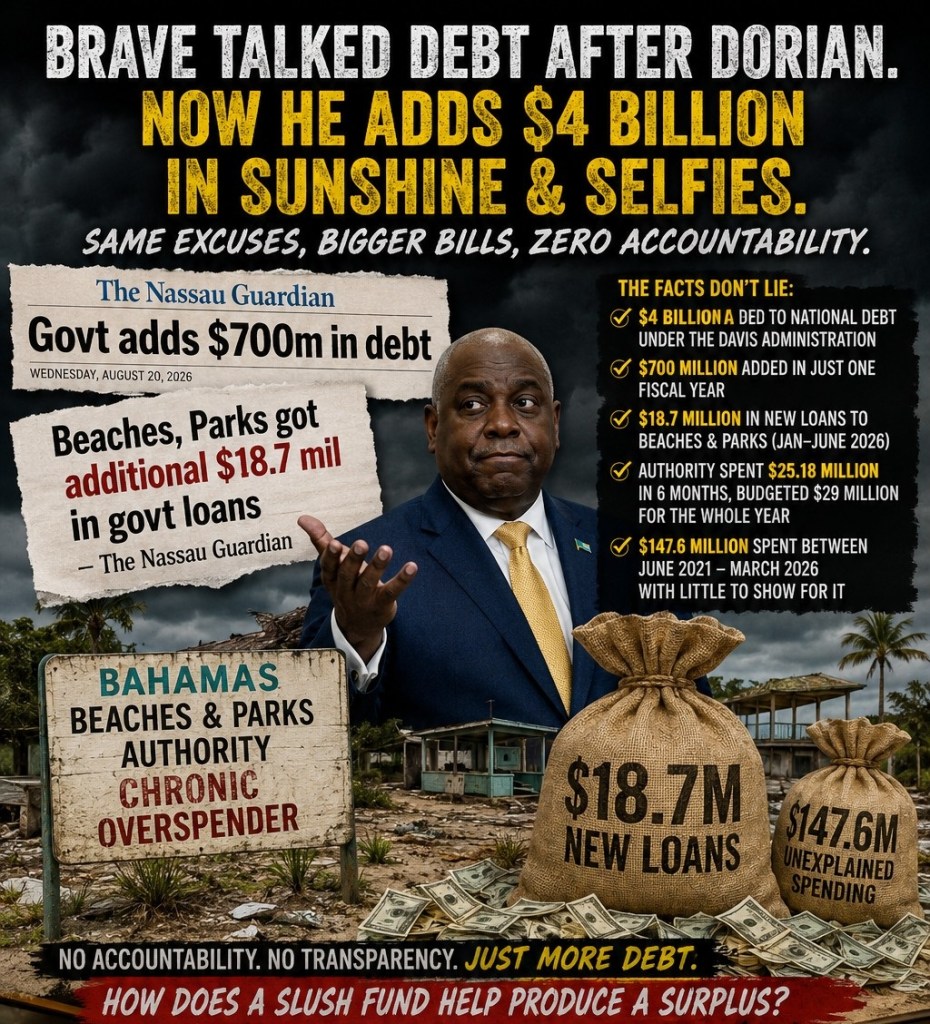
Public disclosures indicate that the Bahamas Public Parks and Public Beaches Authority reportedly spent approximately $31 million against a $24 million budget between July 2024 and March 2025.

That is roughly a $7 million overrun.

So, here is the question no one seems eager to answer:

If Beaches and Parks is overspending its allocation, why are maintenance contracts allegedly being terminated?

And if contracts are terminated, is prison labour being used as a cost-saving substitute?

Or is it being used as a politically convenient substitute?

Because here is the part no one is saying out loud:

If an existing contractor was displaced, the government may still have financial obligations tied to that arrangement. You do not simply erase cost by replacing workers with inmates. Oversight, supervision, equipment, and administrative expenses still exist.

Which means this is either:

  • A budgeting problem,
  • A political problem,
  • Or both.

The Chairman of Beaches and Parks, McKell Bonaby, owes the public a detailed accounting of where the money went—especially in a year of overspending.

Transparency should not be seasonal.

The troubling pattern here is not that politics is being played. Politics is always played.

The troubling pattern is selective indignation.

When an opposition candidate has no charges, no indictment, and no legal link to a crime, the PLP demands moral purification.

When a sitting PLP MP alleges sabotage from within his own party and questions swirl about contract terminations and prison labour substitution, the silence is deafening.

If standards matter, they must apply evenly.

If accountability matters, it must apply internally.

If evidence matters, it must matter all the time—not just when it is politically convenient.

Until then, calls for resignation will sound less like principle and more like performance.

And Bahamians are smart enough to know the difference.

The Progressive Liberal Party fails for one reason; it is their nature.

END

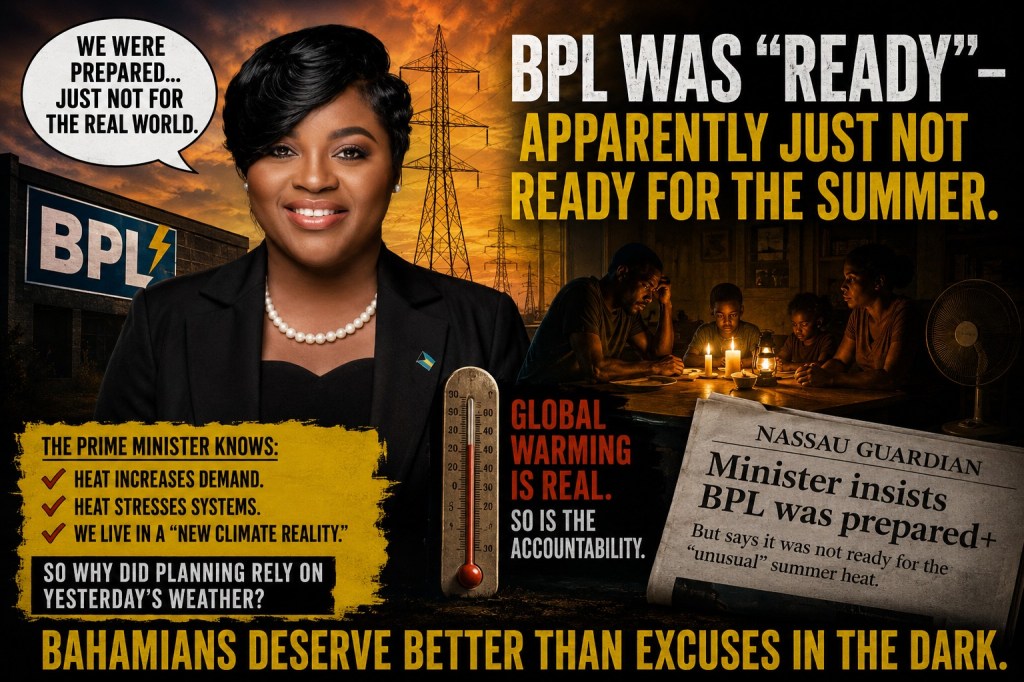
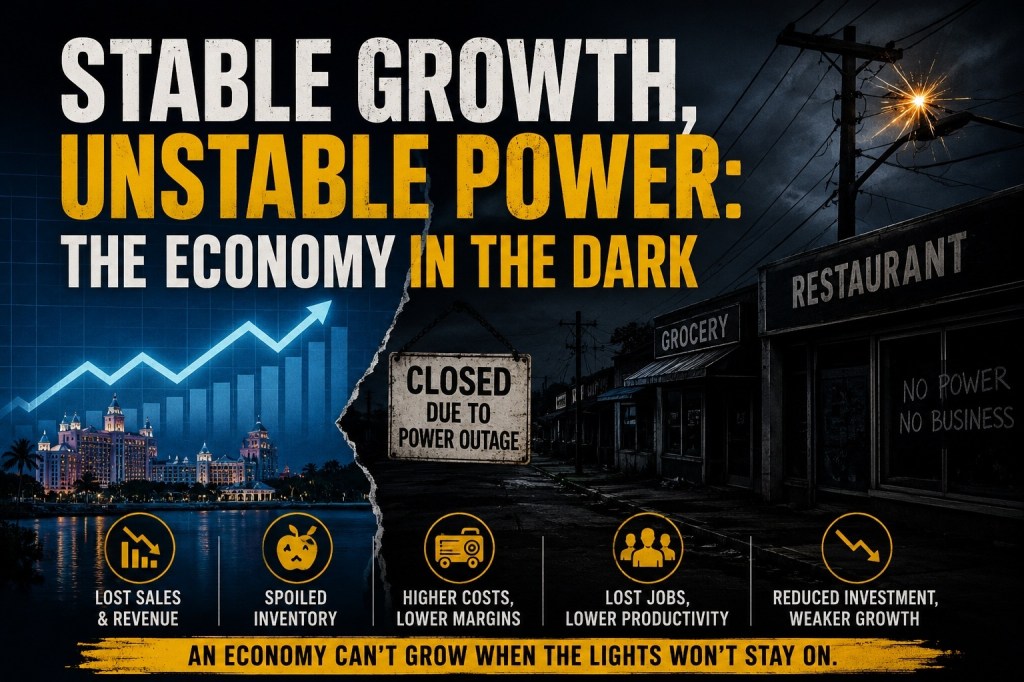
My Morning Paper 23 February 2026 – Energy Reform of Energy Lockdown?

This morning, while the country was watching the public back-and-forth between the Office of the Prime Minister and EyeWitness News over the status of the Grand Lucayan deal, another set of documents quietly demands attention — the energy reform agreements involving Bahamas Power and Light (BPL).

Now, I’m not saying anything is wrong. Not at all. I’m just asking questions. You see, sometimes the details tell you more than the headlines do.

According to reporting by The Nassau Guardian, the Davis administration released more than 3,000 pages of energy reform agreements outlining Power Purchase Agreements (PPAs) between BPL and several private companies. These companies will build, own, and operate solar and LNG generation facilities on Family Islands, and BPL will purchase electricity from them at contracted rates.

The government describes this as a “sweeping energy reform effort” designed to “right-size” BPL and modernize operations at a utility that has faced long-standing financial challenges.

Now that word — “right-size.” I wonder. What exactly does that mean?

Does it mean reducing BPL’s generation footprint?
Does it mean shifting risk to private operators?
Does it mean downsizing staff?
Or does it simply mean transferring generation assets into private hands while BPL becomes primarily a purchaser and distributor?

Because under these PPAs, BPL does not own the new plants. The private entities do. They build them. They operate them. They own them.

One of the disclosed agreements involves Andros Renewable Energy Co., which proposes:

  • Central Andros: 0.4 MW solar + 2 MW LNG
  • North Andros: 0.4 MW solar + 2 MW LNG
  • South Andros: 0.2 MW solar + 1.6 MW LNG

That totals 1 MW of solar and 5.6 MW of LNG.

Now, forgive me, but when something is described as renewable reform, and the overwhelming capacity is LNG — that’s still imported fossil fuel — one has to ask: is this diversification or substitution?

The LNG for these plants is to be supplied from a terminal at Clifton Pier, developed by Freeport Oil Company Ltd. in partnership with Shell North America.

Which raises another gentle question: how much of this structure represents true Bahamian ownership and control? If generation, fuel supply, and logistics are concentrated among a small group of external partners, where exactly does long-term energy sovereignty rest?

Let’s talk pricing.

BPL is to pay:

  • 25 cents per kWh (base rate)
  • 13 cents per kWh (LNG logistics)

Total: 38 cents per kWh.

Now, Deputy Director of Energy Verron Darville reportedly stated that it costs BPL more than that to currently generate power in Andros and that Family Island losses amount to roughly $50 million annually — subsidized by New Providence operations.

If that is accurate, then 38 cents could indeed represent a reduction in BPL’s internal generation cost.

But here’s the quiet part.

38 cents is what BPL pays the generator.

Consumers pay:

  • Generation
  • Transmission
  • Distribution
  • Administrative overhead
  • Fuel surcharge adjustments

So one might wonder: after BPL’s additional costs are layered in, what does the final consumer rate look like? The government says there is no change to the national pricing structure. But over 15- to 25-year PPA terms — which are typical for such agreements — how will adjustment clauses affect pricing?

Because some components of these contracts are:

  • Variable
  • Subject to annual adjustments
  • Not yet fully determined

And LNG pricing, as we know, is tied to global markets.

If LNG prices spike, who bears that risk?
Is it the generator?
Is it BPL?
Or is it the Bahamian ratepayer?

And if the logistics portion — 13 cents per kWh — is adjustable, what mechanisms cap that exposure?

Then there is the logistical dependency.

All LNG originates from Clifton Pier on New Providence and must be transported to Andros. That introduces:

  • Supply chain vulnerability
  • Weather exposure
  • Terminal performance risk

If there is disruption at the LNG terminal or in marine transport, what redundancy exists for Family Island supply?

Now, let’s be clear.

If these agreements are well structured:

  • Family Island losses could shrink.
  • Government subsidies could decline.
  • BPL’s balance sheet could stabilize.
  • Diesel dependence could decrease.
  • Emissions could improve relative to heavy fuel oil.

That is the optimistic case.

But if pricing assumptions are miscalculated, or escalation clauses are too generous, The Bahamas could be locked into long-term payment obligations — even if future solar and battery storage technologies become cheaper.

That is the structural risk inherent in long-term PPAs.

So perhaps the real issue isn’t whether 38 cents sounds high.

The real questions might be:

  • Is 38 cents materially lower than BPL’s fully loaded current production cost?
  • What is the exact PPA term length?
  • What are the escalation formulas?
  • Who bears fuel price volatility?
  • What are the termination or buyout clauses?
  • How much Bahamian equity participation exists?
  • What independent cost benchmarking was done before signing?

Because without full clarity on those points, it becomes difficult to determine whether this is transformative reform — or simply the relocation of financial risk from one column of the national ledger to another.

I’m not suggesting anything, you understand.

I’m just asking.

Because when a nation signs decades-long energy contracts, it’s not merely buying electricity.

It’s defining its economic structure, its fiscal exposure, and its sovereignty over a system every Bahamian household depends upon.

So, these are my thoughts on the Energy Reform initiative as proposed by the New Day Progressive Liberal Party (PLP) government and elevation of them.

END

My Morning Paper 20 Feb. 2026 – $39 Million for Harbourside… Because Plans Are Optional Now?

“The Government is paying $39m over a ten-year period to acquire the recently completed Harbourside in-patient facility on East Bay Street from Doctors Hospital…” – On 4th December 2025.

According to Michael Darville, Minister of Health and Wellness, the agreement is structured as a 10-year lease-to-own arrangement — 120 monthly payments — totalling $38.9 million. The facility is being acquired to temporarily house the maternity and legacy wards while long-delayed renovations are carried out at Princess Margaret Hospital (PMH), specifically the kitchen and related infrastructure.

Let’s be clear: those are the publicly stated facts.

Now let’s talk about the part that apparently lives in the forgotten archives of government memory.

The Renovations That Were Already Underway

Under the former Free National Movement’s (FNM’s) administration of Hubert Minnis, there were announced and initiated plans to renovate and modernize sections of PMH, including improvements to critical services. The maternity ward and broader hospital upgrades were part of a phased redevelopment plan intended to keep services centralized while improvements were made.

That was the plan.

Fast forward. Instead of accelerating and completing those renovations in sequence, we now find the government committing nearly $39 million to acquire a private facility to house services that were already supposed to be accommodated within the public hospital’s redevelopment framework.

So naturally, taxpayers might ask:

If the renovation plan had been followed, prioritized, and executed on schedule — would this $39 million expense have been necessary?

Lease-to-Own… or Pay Twice?

The Minister has framed the arrangement as fiscally responsible — spreading payments over 120 months to “ease the burden” on the Treasury [The People].

But here’s the arithmetic problem:

  • Renovations at PMH were already contemplated.
  • Temporary relocation becomes necessary only when renovation sequencing is delayed or mismanaged.
  • Now taxpayers are funding:
    1. The PMH renovations (still ongoing),
    2. A $39m acquisition of a private facility to temporarily house wards,
    3. AND a proposed $267 million specialty hospital, reportedly to be built in western New Providence — largely focused on maternal and specialized women and children care.

At some point, this stops looking like strategic healthcare planning and starts looking like a very expensive game of musical chairs.

The $267 Million Question

While committing to the Harbourside acquisition, the government is also advancing plans for a $267 million specialty hospital project in western New Providence — described as being heavily maternity-focused.

So, let’s recap:

  • We are temporarily moving maternity services.
  • We are buying a facility to house maternity services.
  • We are planning to build a new hospital centred around maternity services.

One could be forgiven for wondering whether there is a unified master plan — or whether each announcement is simply a reaction to the last unfinished announcement.

Project Management, Bahamian Edition

If the prior renovation plan had been executed efficiently and without interruption, there is a legitimate argument that the additional $39 million outlay may have been avoided — or at least reduced.

Instead, the public is now paying for:

  • Delays,
  • Parallel infrastructure,
  • And a long-term financial commitment that will stretch a decade.

All while being told this is the “responsible” solution.

One must admire the confidence.

Because in any other setting — whether in architecture, development, or private enterprise — abandoning an existing renovation plan, incurring millions in additional acquisition costs, and layering on a $267 million capital project would trigger some very serious questions about coordination, sequencing, and oversight.

I would genuinely love to meet the person doing the project management on this. Not to criticize — just to understand the flow chart. Because from the outside looking in, it appears the only thing spreading faster than hospital services across New Providence… is the invoice.

It is my opinion that healthcare infrastructure requires continuity, sequencing, and disciplined execution. When administrations change, patients should not become casualties of political resets.

The public deserves transparency on:

  • What specific PMH renovation plans were inherited,
  • What timelines were altered or delayed,
  • Why the Harbourside acquisition became necessary,
  • And how this integrates with the proposed $267m specialty hospital.

Because $39 million is not pocket change.

And if proper follow-through on existing plans could have prevented it, then taxpayers are not just funding healthcare — they are funding preventable inefficiency.

The people of The Bahamas deserve answers.

The people of The Bahamas deserve better.

The Progressive Liberal Party (PLP) fails for one reason; it is their nature.

END

My Morning Paper- 19 February 2026 – Cancelled, Contradicted, and Condescending

For a government that frequently asks the Bahamian people to “trust us,” the record tells a far more complicated story — one filled with reversals, cancellations, and now, contradictions from within its own ranks.

When the Progressive Liberal Party (PLP) returned to office in September 2021 under Prime Minister Philip Davis, one of its early decisions was to halt the loan arrangement put in place under the Minnis administration for renovations to Princess Margaret Hospital (PMH). The Davis administration stated at the time that it was reviewing and restructuring the financing arrangements. It is also a matter of record that funds associated with that loan facility were returned.

Fast forward to today: major redevelopment works at PMH have not been completed, and the facility continues to face well-documented infrastructural challenges. While the government has announced phased redevelopment plans and alternative financing strategies, the reality is that the comprehensive transformation initially anticipated has yet to materialize. For a hospital long described as being in urgent need of modernization, delay carries consequences.

Similarly, in Grand Bahama, the Davis administration cancelled the prior agreement involving the sale of the Grand Lucayan Resort. The PLP argued the deal negotiated under the Minnis administration was not in the best interest of the Bahamian people. That was a policy decision within their authority.

However, more than four years later, a finalized and executed sale that brings sustained economic revitalization to Grand Bahama has not been completed. Announcements have been made. Negotiations have been referenced. But a transformative, closed deal delivering clear economic relief to the island remains outstanding. The criticism here is not about the right to cancel a deal — it is about the obligation to replace it with something demonstrably better within a reasonable timeframe.

Then there is fuel hedging at Bahamas Power and Light (BPL).

Public reporting from The Nassau Guardian documented a dispute between the former BPL CEO, Whitney Heastie, and Energy Minister JoBeth Coleby-Davis over whether the hedging program implemented under the Minnis administration produced savings.

Heastie’s October 18, 2021, letter to then-Minister Alfred Sears asserted that the hedging strategy had already saved approximately $30 million over 13 months and projected up to $55 million in savings by January 2022. He further stated that because fuel costs are passed directly to consumers, those savings translated into reduced fuel charges.

Minister Coleby-Davis later publicly disputed that characterization, stating that due to the operational state of the Clifton plant and fuel mix realities, there were “no savings” in practical terms. The Davis administration also acknowledged inheriting approximately $100 million in fuel-related debt.

The controversy deepened when the government declined to execute additional hedge trades that BPL’s hedging committee and board had reportedly recommended in order to lock in lower fuel prices. Both Minister Sears and Prime Minister Davis publicly stated they were not advised that those trades needed to be executed — a claim the Opposition challenged.

Here lies the broader issue: when a former CEO documents savings, an Energy Minister says there were none, and the Prime Minister states he was never advised — yet the public is later told to simply trust that a new hedging strategy will be better — confidence becomes strained.

If there were no savings, why did BPL’s own documentation project millions in cost reductions?
If there were savings, why were subsequent trades not executed?
If Cabinet was not properly briefed, what does that say about internal governance?
And if it was briefed, who is contradicting whom?

The Prime Minister cannot reasonably ask the Bahamian people to “trust the process” while appearing unaware of what his ministers were being advised — or while his ministers publicly contradict documented positions from state executives.

Equally troubling is the tone sometimes adopted toward critics. When members of the public question inconsistencies, they are occasionally met with condescension — as though they simply “do not understand.” But the information now being used to defend government policy was not always proactively shared with the public at the time decisions were made. You cannot withhold clarity, then criticize citizens for lacking it.

Leadership requires coherence. It requires transparency. And above all, it requires that a Cabinet speak with one factual voice.

As a general election approaches, the Bahamian people will weigh not just promises of a new hedging program, or renewed hospital plans, or future deals for Grand Bahama — but the track record of cancelled agreements, delayed replacements, and internal contradictions.

Trust is not demanded.
It is earned.

The Bahamian people deserve better and the Progressive Liberal Party (PLP) fails for one reason; it is their nature.

End